
MSK Cancer Center
Creating a behavioral design methodology that bridged the gap between science and design at a leading cancer research institution
Team of 3 Fellows
Workflow Optimization
Ethnography

Memorial Sloan Kettering's Design and Innovation Group (DIG) had a behavioral scientist on staff who wanted to integrate evidence-based behavioral science into the design process. But there was tension: the linear, rigorous nature of behavioral science clashed with the iterative, rapid nature of design.
The behavioral scientist had strong opinions about how design solutions should be vetted. Designers felt constrained by scientific methodology. Both parties needed a shared language to collaborate productively and convert scientific theories into actionable design solutions.
The Challenge
Core Questions
- {{ q }}
Our Approach
Our fellowship team started by understanding the friction. I interviewed DIG team members, observed prototyping sessions, and reviewed past collaborations between designers and the behavioral scientist. I discovered that previous attempts at integration had varying success. Sometimes behavioral science helped, sometimes it felt like a bottleneck.
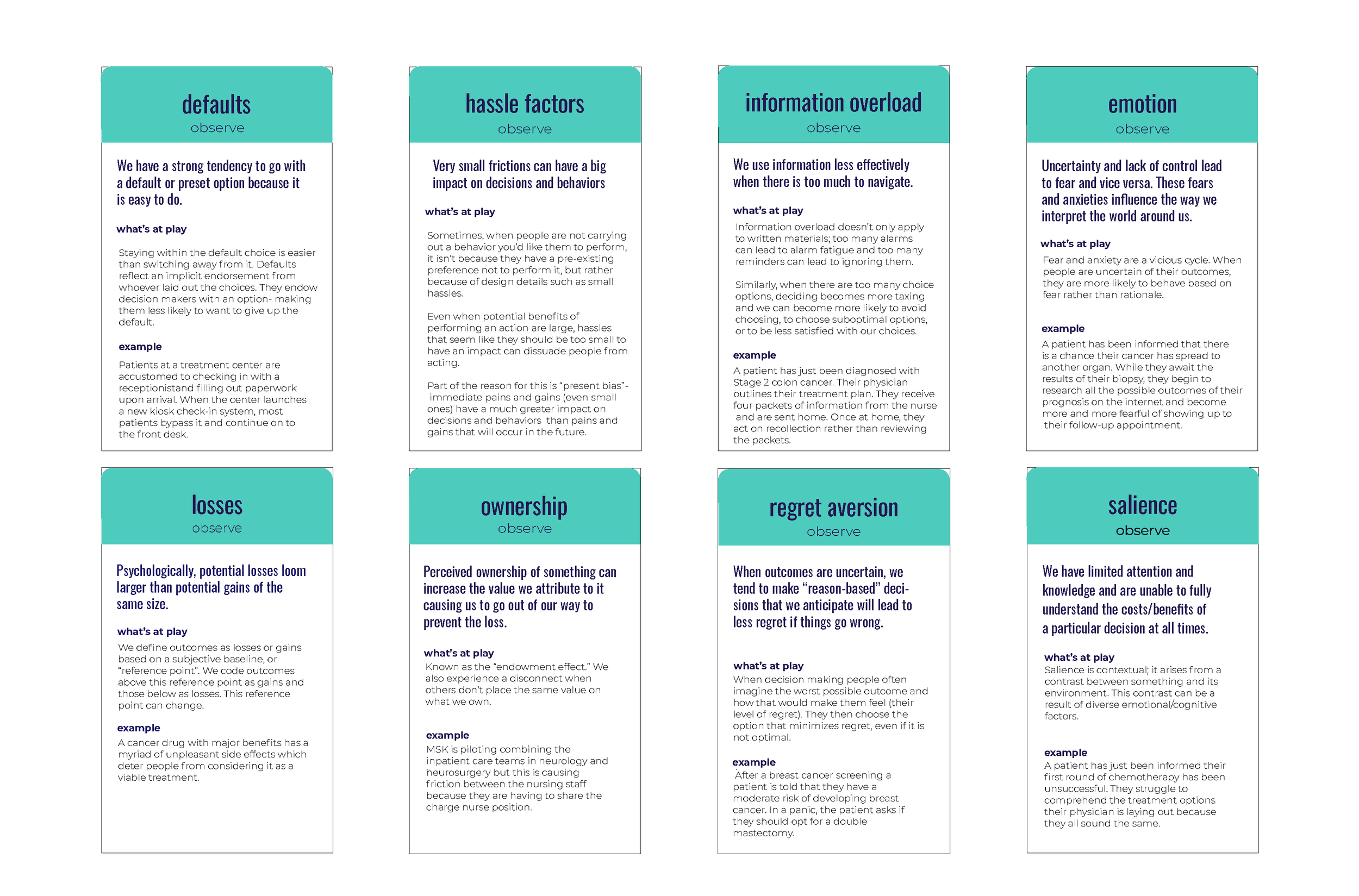
Through collaborative design sprints and workshops, we worked with both designers and the behavioral scientist to map their design process and identify "infusion points" where behavioral science insights could strengthen outcomes without slowing iteration. We reviewed 20 core behavioral science principles and identified which ones designers encountered most frequently in their work.
Key Insight: Behavioral Science as Stakeholder Buy-In Tool
Designers found behavioral science principles most helpful not during ideation, but when developing stakeholder buy-in for design decisions. In a hospital system with clinical leadership, compliance officers, and operational teams, garnering buy-in happens at multiple stages — and without it, designers risked wasting hours of R&D on solutions that would never be approved.
Behavioral science gave designers a credible, evidence-based language to advocate for design decisions with skeptical stakeholders.
The Solution: B-Card Methodology
Through co-design sessions, we created the B-Card methodology — a flexible framework for incorporating behavioral science insights into the design process. Rather than forcing designers to adopt linear scientific methods, the framework met them where they already worked.
The breakthrough came when we realized designers were already comfortable using card decks to prompt ideation. We leveraged that mental model and created a deck of cards featuring behavioral science principles, each with:
Impact and Milestones
{{ i.body }}
Behind-the-Scenes
The hardest part wasn't creating the framework; it was navigating the interpersonal dynamics between the behavioral scientist and designers. Both parties were brilliant, but they spoke different languages and had different success metrics.
I had to facilitate workshops where we could surface disagreements productively, find common ground, and co-create something neither side could have built alone. The B-Cards worked because both parties felt heard and contributed to the final solution.
Let's Work Together
Available for full-time and fractional contract engagements. If your team is struggling to navigate complexity, let's talk.